Processing of honey : how to?

•Use a hot rod or knife to de-cap the
 honeycombs (by passing it over the
combs).
•Place the de-capped comb on a piece
 of fine white linen tied over the top
of a plastic container. The de-capped
side should face downwards.
•Let the honey drip through the cloth
 until the cells are empty.
•Turn over the comb and repeat the
 above process.
•Pack honey in clean, dry jars with
 well-sealed lids. Label with date
harvested and store in a cool place.


Honey harvesting :how to?

Honey harvesting
For traditional and top-bar hives, harvest once or twice a year. For the Langstroth hive,
harvest three or four times a year.
Steps in harvesting honey:
  • Wear protective clothing: overall, veils, gloves, boots 
  • Light smoker
  • Gently open the hive
  • Select combs that are two-thirds sealed full of honey
  • Avoid combs with brood
  • Lift comb, blow smoke on both sides and gently brush bees back into hive with a feather
  • Cut away combs and honey, leaving about 1 cm of comb on the bar
  • Place capped honey in a clean, dry container and cover
  • Leave at least eight combs for the bees
  • Before closing hive, push the unripe combs next to the combs with brood and place harvested bars behind these.

Populating the hive: how to

There are two ways of populating a swarm:

1. Baiting a swarm

•Use a small hive that has already been inhabited by bees and fill it with frames or top
bars; two of the frames should contain combs and the others should have foundation
sheets or strips of old comb.
•Place the hive in a tree or on a roof in such a way that there is some protection from
the wind.
•Place the hive in its desired place the very day that the swarm has taken occupation of
it.
•Baiting is useful only in the swarming season, usually at the beginning of the dry season
and end of a cold season.


2. Capturing a swarm

You may capture a newly settled swarm around a branch of a tree, but make sure you wear
protective clothing.
•First sprinkle cold water over the bees with a brush or spray bottle to stop them from
moving away.
•Hold a small hive without frames, a basket or a box under the swarm.
•Drive the bees into the hive with a bee brush or smoke.

Site selection

Beehives should be placed near a source of water (river, stream, lake, dam or natural
or man-made ponds) and in an area with adequate vegetation, such as coffee, sunflower,
moringa, mangoes, oranges, bananas and other flowering plants.
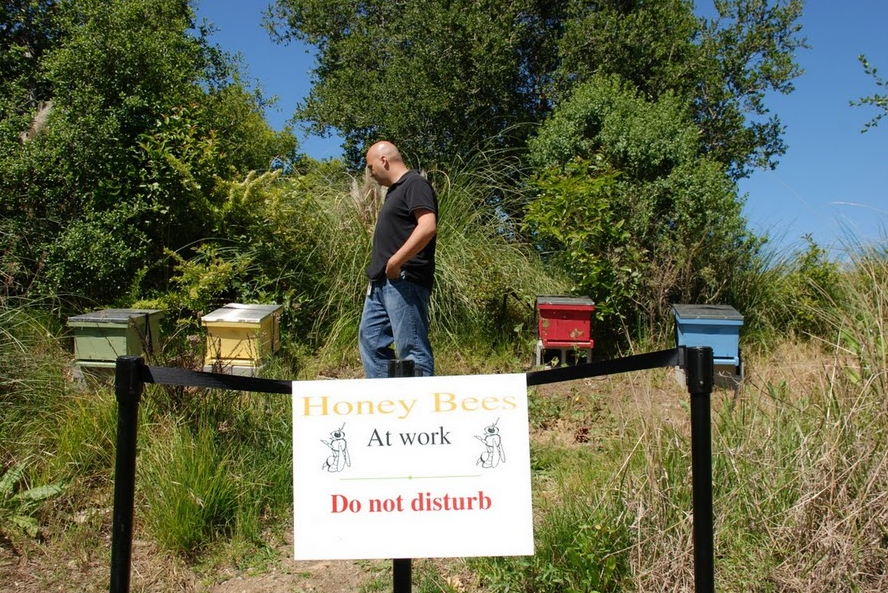
The site should be fenced to protect bees from people and animals (and people and
animals from bees).
Hives should be located at least 30 metres away from roads and public or noisy places.

Choosing the right hive

There are lots of different beehives, but really only 2 major types - moveable frame beehives  and top bar hives

In the Western world, moveable frame beehives are the most common, but there are dozens of different designs. Generally the parts of each are not interchangeable, so you are best to pick one type of beehive and stick with it.


  • The most common designs of moveable frame beehives are
  • The Langstroth Hive
  • The National Hive
  • The Commercial Hive
  • The WBC Hive

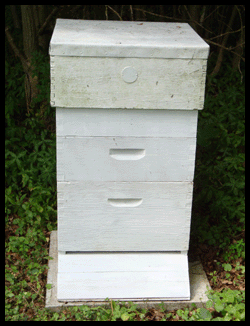
 The Langstroth Hive

Before the invention of the modern beehive, bees were kept in upturned baskets called skeps. When the honey was harvested the colony was destroyed and all the bees killed, which was obviously not good for either the bees or the beekeeper.

In the mid 19th century, Reverend LL Langstroth patented a 'moveable frame' beehive. This was based on the idea of 'bee space' - if the correct space is left between the frames, the bees will neither build comb in the space nor cement it shut with propolis. 

This meant that the frame could be lifted out without destroying the hive, and was truly revolutionary. Rev Langstroth is still considered the "Father of American Beekeeping."

All modern beehives are still based on the Langstroth Hive, and the Langstroth hive itself is still the most commonly used beehive today - especially in the United States. It is a simple hive in construction and easy to maintain and, especially if it is common in your area, is often a good choice.

The National Hive

The National Hive is a variant on the Langstroth, and is the most common hive in the UK. It has a much smaller brood box than the Langstroth.

Some beekeepers argue that it has too little brood area for the modern productive bee. Although you can overcome this by adding on another super to the brood box (known as a "brood and a half"), one drawback is that it makes it more difficult to locate the queen.

The supers are also smaller, and this has the advantage that they are much easier to handle when full of honey.


The WBC Hive

 The WBC Hive is the classic traditional beehive, named after its designer William Broughton Carr. Unlike the other moveable frame hives which are single walled, the WBC hive is double walled. The outer part is made up of pyramid sections, giving the WBC it's distinctive look.  The inner part is separate loose boxes which contain the frames.Its main advantage is that it stays cool in summer and warm in winter. Also, because it is double walled, the supers themselves are thinner and so lighter to handle

The main problems with WBC hives are that they are a complicated design and cumbersome to work with. To get at the supers, all the outer sections have to be removed first, so in practical everyday terms they really are inferior to the other beehives.


The Commercial Hive
The Commercial Hive, as the name suggests, is best suited to commercial beekeepers. It is very similar to the national hive, except that the frames are deeper and so hold more honey.

While this can be seen as an advantage, it does make them heavy and difficult to handle manually when they are full of honey. For this reason, hobbyist beekeepers tend to stick to the lighter, more manageable beehives.
There are many other beehive designs based on the Langstroth hive. The Dedant is popular in France, the Smith common in Scotland, and too many others to mention have their regional followers.

Which one you choose will be influenced by a lot of factors, including price, materials, availability, and local conditions. A good general guide is stick to what is popular with local beekeepers in your area -  a beehive which works for them will likely be a good beehive for you too


Why keep bees?

Why keep bees?
•Bees pollinate crops and thus help increase
yields
•High demand for honey exists in local,
regional and international markets
•Propolis, collected from plants by bees to cover the inside of the hive, treats a broad
range of ailments
•Pollen, collected from plants by bees to feed their larvae, is used in the perfume industry,
and is a food additive and a medicine
•Royal jelly, made by young bees from gland secretions and fed to the queen to make her
strong, has medicinal properties
•Beewax is used in cosmetics, candles and polishes
•Beekeeping has low start-up costs and occupies negligible land space
•About 80% of honey consists of sugars that are readily absorbed by the body and honey
is thus quite suitable for children, sick people and those who perform heavy manual tasks.

How to Keep Bees and Process Honey

Asaf Ayatuhaire, from Bushenyi District in South
Western Uganda, has more than 100 beehives
of different types. With an annual production of
honey of around 2,000 kilogrammes, he earns
more than US$ 2,200 a year and has recently
registered a company, West Honeys Uganda.
But ten years ago, Asaf had just three traditional
hives and produced only six kilogrammes of
honey a year. Then he attended a national
training of trainers programme, organized and
sponsored by the Entomology Department of
the Ministry of Agriculture. After completing
his training, he became involved in training
other beekeepers in his local communities.
Asaf was also able to interact with NGOs
and international and local funding agencies,
such as USAID, FAO and the District Farmers
Association. These agencies helped him to
expand his apiary and acquire improved top-bar
hives.
Today, thanks to beekeeping, Asaf has a
permanent house, pays fees for his children in
secondary and higher education and is able to
save from his income.