Why do bees make honey?

Bees make honey as food for themselves and for their offspring. It provides
them with the energy they need for their flights to a field, and heat to keep their
bodies and dwelling warm; and for the secretion of wax for comb building.
Bees store surplus honey for a rainy day and feed on this honey all year round
for their survival, particularly during the cold winter months when no flowers
and nectar available. An average colony requires about 40 to 100 kg of honey to
maintain itself through a year.

Honey making

Making honey is the most important job of foraging bees. They fly diligently
and tirelessly every day from morning till dusk in all directions and at various
heights and at a distance of 3 to 5 kilometers from the hive prospecting for
plants and trees producing nectar which they collect from the heart of flowers.
Nectar is the basic raw product from which honey is made. It is a mixture of
water and sugar that flowers produce from their nectaries. Nectar contains 20 to
60% sugars generally cane sugar. The water content varies between 40 to 80%.
Besides sugar, nectar contains minerals, organic acids, vitamins, pigments and
aromatic substances.
Bees generally collect nectar in the warm months of the year, from spring
through to autumn.

Both foragers and nurse bees are involved in the process of honey making. The
process begins when a forager leaves the hive looking for flowers to collect
nectar. When a flower is found, the bee sucks the nectar out of the flower with
her proboscis (tongue) and stores it in a special sack in her body called the
honey stomach to be transferred to the honey-making bees in the hive. The
honey stomach holds about 4 mg of nectar that is about half the weight of the
bee. If the nectary is empty the bee flies to another flower. A bee may need to
visit between 50 to 150 flowers in order to fill her honey stomach depending on
the flower species. For instance, a load can be obtained from a few rich-nectar
producing flowers such as eucalyptus or citrus whereas a load can be obtained
by visiting hundreds of small flowers of clover. It takes about 30 minutes to
several hours to collect a load, depending on how plentiful and how far away the
nectar source is. A forager may take hours to collect a load in poor foraging
conditions.
When the honey stomach is full the bee flies back to the hive. On her way back
the bee adds invertase, an enzyme from her body to the collected nectar. This
begins the process of changing the nectar into honey. The enzyme breaks the
complex plant sugar in the nectar down into simpler and more digestible sugars
for the bees, mainly glucose (grape sugar) and fructose (fruit sugar).
A close-up view of the proboscis, the organ with which a worker bee sucks up nectar and water.


An illustration of internal anatomy of a bee showing the honey sac.

In the hive the nectar is delivered to the house bees who store it in the
honeycomb cells. In the cells water has to be evaporated off the nectar. House
bees on the comb fan their wings to evaporate and thicken the nectar converting
it into honey. Ripened honey has moisture of 17 to 20%. Further enzymes added
to prevent it from fermentation and attack by bacteria while it is stored in the
hive. Once this process is finished the house bees will then cover the top of each
filled up cell with a thin beeswax cap to make it airtight, sealing it for future use.
When this is done, they move to the next empty comb starting all over again.


A typical colony can produce 30 to 50 kg of surplus honey per year. The bees in
the same colony visit about 4 million flowers to make one kilogram of honey.
The honeys they produce vary in color, flavor and viscosity; this difference
depends upon the floral source from which the nectar was derived. The nectar
from some plants produces a light, mild flavored honey. Nectar from other
plants produces a dark, strong flavored honey.
Honeybees will go on collecting and storing more nectar as long as there is
nectar available in the pasture and there are empty cells in the hive to store it in,
however much abundance of honey the hive contains. A returning forager with
load of nectar makes her way to the combs and begins to inform the others about
the source and direction of nectar to recruit more foragers to the area of nectar.
She does so by performing special movements on the surface of the comb
known as “dance” and does that for seconds or a minute. While she is dancing
some bees gather closely around her and learn from the dance and touch her
with their antennae. The dancing forager makes stops to give nectar to those
bees following and watching the dance to learn its scent and taste. The dancer
then runs to another place on the combs and repeats the dance before another
group of bees. After the dance has ended, she makes another trip to the source of
nectar, and those bees who have followed the dance leave the hive to search for
the nectar. When the recruited bees return to the colony with load they in their
turn recruit more bees.
Foragers perform different dances to convey different information. When the
source of nectar is near the hive i.e., less than 100 meters away the forager will
perform a round dance, and if is far away the bee will perform the waggle dance.
The round dance
During the round dance the bee runs around in a little circle first one way, then
turns round and runs in the opposite direction of the circle. The round dance
tells the bees that the food is near the hive and of its taste and smell, but gives no
information about the direction of the food source.

The colony of the honey bee

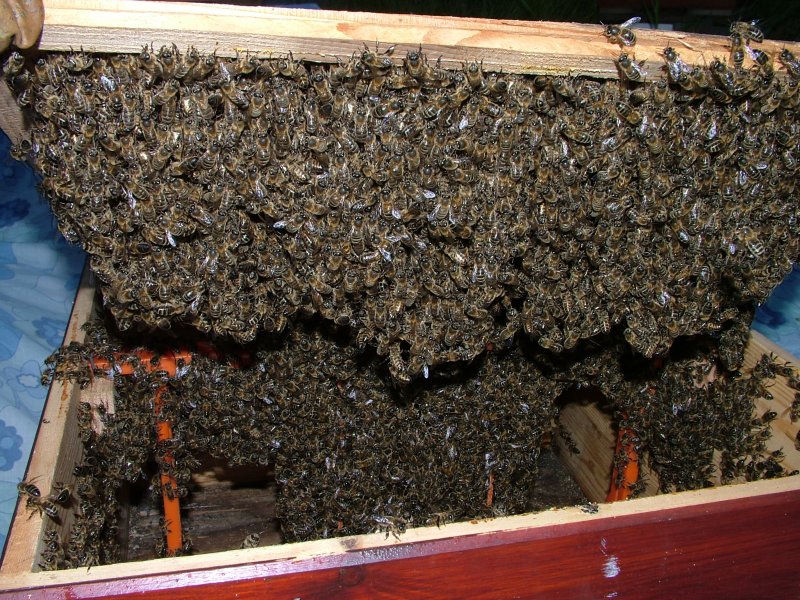
The honeybees are social insects living together in large group or family called a
colony. The bees' nest inside the hive consists of several wax combs each
containing many cells in which bees use for rearing their baby bees and to store
food. The bees organize their affairs so well in their dwelling and devote
themselves to the welfare and survival of their colony.
A bee colony is made of three different castes: A queen, worker bees who form
the great majority of the colony and the drones. The queen is the mother of the
colony whose only function is to lay eggs from which all bees develop. The sole
function of the drones is to fertilize the virgin queens, whereas the worker bees
perform all tasks that the colony needs. In summer the colony contains 40,000 to
80,000 worker bees and a few hundred drones and in winter about 10,000 to
20,000 worker bees and no drones. Bees born in spring or in summer live on the
average no more than six weeks, whereas those born in September or later live
six months and more. This seasonal variability in the life span of individuals is
due to the fact that spring or summer bees do much work with a lot of energy
spent, and that those emerge in autumn stay inactive within the hive huddled
together in a cluster during the wintertime and eat the stored food.
A worker bee, after emerging from her birth cell as a mature bee lives
approximately six weeks in summer, spending the first three weeks of her life
inside the hive and is termed a house bee or nurse bee. In this stage she cleans
cells, feeds the older and young bees, feeds the queen, builds wax combs, stores
nectar and seals the honey cells, removes debris and dead bees, ventilates the
hive and guards the hive entrance. After this period she becomes a field bee
(forager) and works the second half of her life outside the hive collecting nectar,
pollen, propolis and water.
Bees are vegetarians. They eat two kinds of food, honey and pollen; honey is
made from the nectar of the flowers and provides the bees with carbohydrate.
The pollen is derived from the anthers of flowers and is the source of protein,
vitamins and minerals.


Processing of honey : how to?

•Use a hot rod or knife to de-cap the
 honeycombs (by passing it over the
combs).
•Place the de-capped comb on a piece
 of fine white linen tied over the top
of a plastic container. The de-capped
side should face downwards.
•Let the honey drip through the cloth
 until the cells are empty.
•Turn over the comb and repeat the
 above process.
•Pack honey in clean, dry jars with
 well-sealed lids. Label with date
harvested and store in a cool place.


Honey harvesting :how to?

Honey harvesting
For traditional and top-bar hives, harvest once or twice a year. For the Langstroth hive,
harvest three or four times a year.
Steps in harvesting honey:
  • Wear protective clothing: overall, veils, gloves, boots 
  • Light smoker
  • Gently open the hive
  • Select combs that are two-thirds sealed full of honey
  • Avoid combs with brood
  • Lift comb, blow smoke on both sides and gently brush bees back into hive with a feather
  • Cut away combs and honey, leaving about 1 cm of comb on the bar
  • Place capped honey in a clean, dry container and cover
  • Leave at least eight combs for the bees
  • Before closing hive, push the unripe combs next to the combs with brood and place harvested bars behind these.

Populating the hive: how to

There are two ways of populating a swarm:

1. Baiting a swarm

•Use a small hive that has already been inhabited by bees and fill it with frames or top
bars; two of the frames should contain combs and the others should have foundation
sheets or strips of old comb.
•Place the hive in a tree or on a roof in such a way that there is some protection from
the wind.
•Place the hive in its desired place the very day that the swarm has taken occupation of
it.
•Baiting is useful only in the swarming season, usually at the beginning of the dry season
and end of a cold season.


2. Capturing a swarm

You may capture a newly settled swarm around a branch of a tree, but make sure you wear
protective clothing.
•First sprinkle cold water over the bees with a brush or spray bottle to stop them from
moving away.
•Hold a small hive without frames, a basket or a box under the swarm.
•Drive the bees into the hive with a bee brush or smoke.

Site selection

Beehives should be placed near a source of water (river, stream, lake, dam or natural
or man-made ponds) and in an area with adequate vegetation, such as coffee, sunflower,
moringa, mangoes, oranges, bananas and other flowering plants.
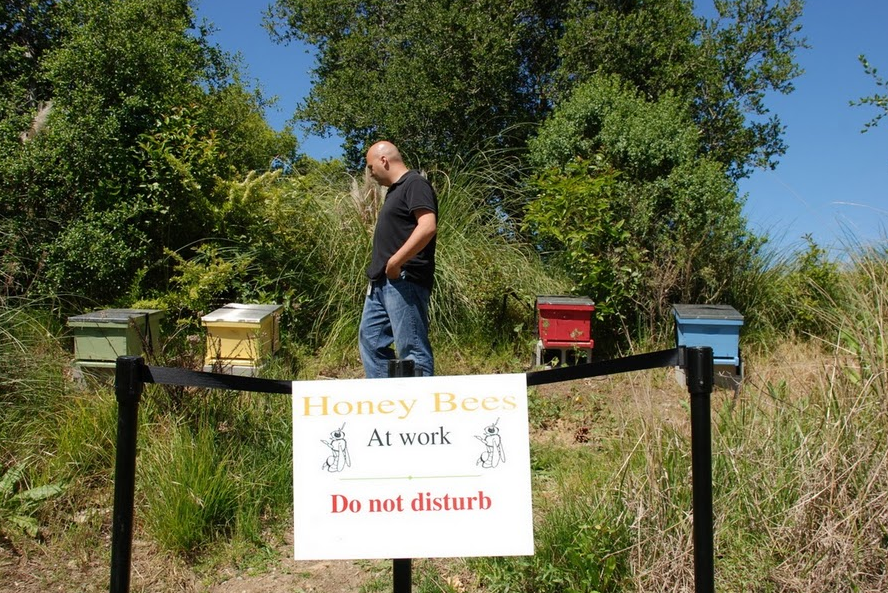
The site should be fenced to protect bees from people and animals (and people and
animals from bees).
Hives should be located at least 30 metres away from roads and public or noisy places.